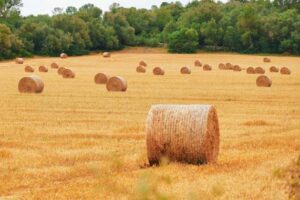
Food prices in 2027 are being influenced by choices made this spring, on farms and in capitals. Credit: Shutterstock
By Maurizio Martina
ROME, May 6 2026 – Across Europe, winter wheat is already in the ground. What farmers apply in the coming weeks will determine the size of this year’s harvest. Those decisions are now being made under a sudden surge in costs that did not exist when seeds went in.
The closure of the Strait of Hormuz in late February disrupted energy and input markets that European agriculture cannot avoid. Within days, tanker traffic fell by 90 to 95 percent. European natural gas prices rose by 70 to 75 percent in the first week, with prices approaching double pre-conflict levels by mid-March.
Meanwhile Brent crude began the year at $61 per barrel and finished Q1 at $118, the largest quarterly price increase on an inflation-adjusted basis in data going back to 1988.
Farmers need immediate, targeted support to sustain the use of fertilizers and other key inputs during this narrow window, and governments should act to keep trade in agricultural inputs open while mobilizing rapid financing for countries under pressure
These shifts shape the cost of energy that underpins farming, from machinery and irrigation to the production of nitrogen fertilizers. At the same time, disruptions to Gulf fertilizer exports—representing roughly 20 to 30 percent of globally traded supply—pushed prices higher across all markets.
Europe, though not directly dependent on Gulf producers, buys into this global price system while also facing higher domestic production costs linked to gas. The result is a sustained increase in input costs at the precise moment farmers decide how much nitrogen to apply, decisions that will shape yields at harvest and are already beginning to set the direction of food prices into 2027.
Two priorities now shape the outcome. Farmers need immediate, targeted support to sustain the use of fertilizers and other key inputs during this narrow window, and governments should act to keep trade in agricultural inputs open while mobilizing rapid financing for countries under pressure.
These measures can still stabilize planting decisions and protect yields. Without them, higher input costs will translate directly into reduced application, lower production, and tighter food supply later in the year.
Rising fertilizer costs are already forcing farmers to adjust input use, with direct consequences for yields and food supply later in the year.
When fertilizer prices rise and liquidity tightens, farmers apply less nitrogen. Lower input use reduces yields. The impact does not appear immediately. It becomes visible at harvest, when production falls below potential, and later in markets, when supply tightens and prices rise. By then, the decisions that shaped the outcome cannot be reversed.
European agriculture enters this crisis with already thin margins and limited capacity to absorb further cost increases. Farmers have faced prolonged financial pressure since the 2022 input cost surge, with rising costs only partially offset by prices.
Climate variability and regulatory pressures add further uncertainty. The current surge compounds these conditions and risks eroding confidence at a critical moment. The resilience of European agriculture depends on whether farmers can absorb shocks of this scale without reducing investment or output.
A further pressure sits at the intersection of energy and food markets. Rising oil prices increase the attractiveness of biofuels, drawing crops such as maize and vegetable oils toward fuel production. This tightens food supply and raises prices further. Europe is deeply integrated into this system. Energy volatility feeds directly into agricultural markets, linking geopolitical risk to food prices and inflation.
The window for action remains open, but it is narrowing. Nitrogen has not yet been fully applied. Spring planting across parts of Europe is still underway. Acting now can limit the damage. Waiting until harvest will not.
The immediate priority is to sustain production. Farmers require timely and proportionate support to maintain input use, particularly fertilizers, during this critical phase.
Current policy responses have focused largely on fuel through tax cuts, price caps and targeted subsidies, while support for fertilizers and broader agrifood inputs remains limited. Existing instruments provide a foundation, but the scale and speed of the shock call for greater flexibility. Clear signals of support, combined with measures to ease liquidity constraints, can influence decisions now and reduce the risk of a contraction in output.
Europe’s response must also extend beyond its borders. As a central actor in global agricultural markets, it has both an interest and a responsibility to support stability. Maintaining open trade in agricultural inputs is essential. Export restrictions imposed by several countries risk shifting the burden onto more vulnerable economies. Europe should lead in opposing such measures.
Access to financing remains critical. Instruments such as the International Monetary Fund’s Food Shock Window can provide rapid support to countries facing acute pressure. Complementary approaches, including the Financing for Shock-Driven Food Crisis Facility facilities developed within the Food and Agriculture Organization, enable earlier and more proactive responses before shocks deepen and spread.
Over the medium term, countries should diversify fertilizer supply sources and strengthen regional coordination. Over the longer term, resilience will depend on more efficient input use, investment in alternative production methods such as green ammonia, and reduced dependence on volatile energy markets. Food production should be treated as a strategic asset, alongside energy and infrastructure.
The decisions taken now will shape outcomes far beyond Europe. Food prices in 2027 are being influenced by choices made this spring, on farms and in capitals. Farmers are adjusting under pressure. The question is whether the response they receive matches the urgency of the moment.
Excerpt:
Maurizio Martina is Deputy Director-General of the United Nations Food and Agriculture Organization

 South African Rand Exchange Rate